Edge Metal, Coping and Gutters in Gastonia, NC
A length of coping that rocks when you push it, with a joint gapped wide enough to take a pencil. It looks like a trim problem, and it is a roof problem. The metal at the edge is what holds the membrane down where wind pulls hardest. When the metal loosens, the sheet beneath it loses its hold line, and a storm that would have done nothing can start to peel a corner. Edge metal is cheap compared with the roof it protects, and it is the first place the roof tells you it is getting tired.
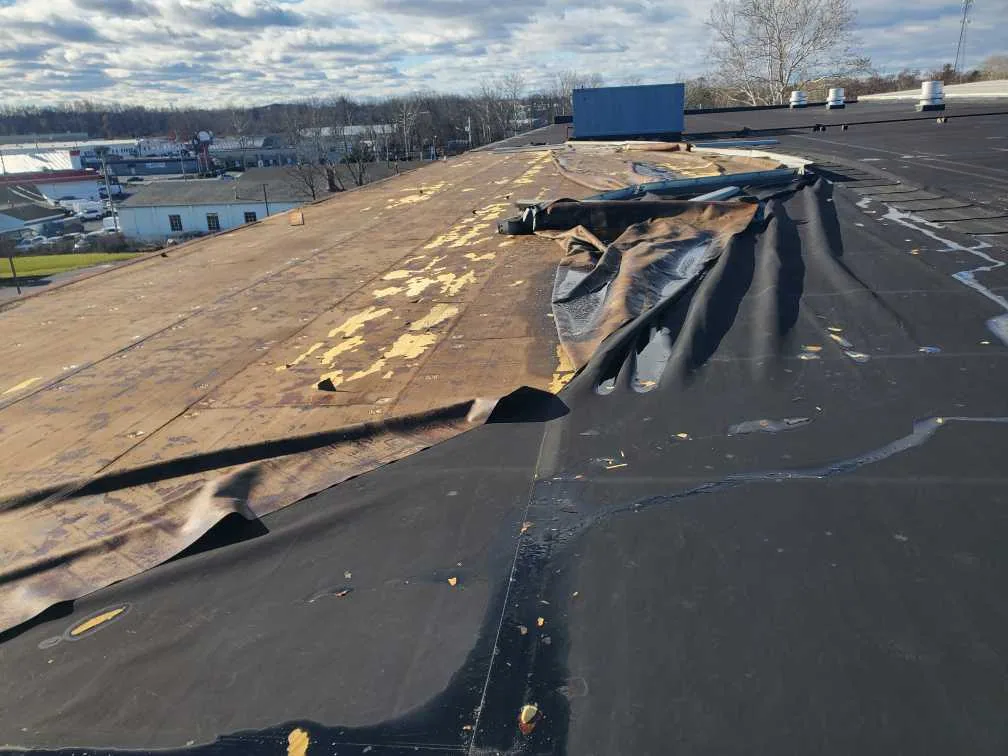
The EF-1 tornado that crossed Gaston County on May 8, 2024 took part of the roof off an East Gastonia warehouse. Edges are where that kind of loss begins, and the wind damage pattern on a peeled roof usually traces back to one loose run.
Inspect Every Foot of Edge
Edge work starts with a perimeter walk. We look at coping caps, drip edge, fascia, gravel stops, scuppers, gutters and downspouts. We push on each length to feel for movement, look for gaps at joints and corners, check fastener spacing, and photograph the sealant. We note rust, dents, loose cleats and missing pieces.
Gutters and downspouts get a flow test. A gutter that overflows at a seam or pulls away from the fascia sends water into the wall and onto the walkway. A downspout that discharges against a foundation can damage the building from below. We count linear feet of each type, and the drains and scuppers that share the edge get their own line, mark problem areas on the plan and rate them by consequence. A loose cap at a roof corner outranks a bent downspout at a back door.
Photographs are taken from the roof and from the ground, so the record shows how the edge reads from both sides. We tag each with a wall elevation and a footage mark. The next inspection repeats the pictures from the same spots. Movement between frames is evidence, and it is easier to see than to describe.
Fasteners get a count. Coping caps are usually secured to a continuous cleat with fasteners at set spacing, and a run where the spacing has widened is a run that will lift first. We mark the spacing we find, compare it with what the roof system calls for and list the lengths that need more. This is the quickest way to improve wind resistance on an older building at modest cost.
Count What a Loose Edge Costs
Wind does the damage, and wind does not wait for the budget cycle. A loose coping joint lets air and water under the membrane at the edge. Air lifts the sheet, flexes the seams and pulls fasteners. Water enters the insulation and spreads along the deck. In a storm, a section of membrane can fold back and expose the roof to rain and flying debris.
The cost of fixing a loose edge before a storm is low: new fasteners, sealant, replacement of damaged lengths. The cost after is high: membrane replacement, wet insulation, interior damage and lost use of space. Gastonia gets summer thunderstorms and the occasional tornado or remnant tropical system; Hurricane Hugo reached Charlotte in September 1989 with gusts of 87 mph. A tight edge is the cheapest defense the roof has.
One blunt line for the memo: a repaired edge is a cheap line item, and an unrepaired edge is the first sentence in a storm claim. After the next storm, the owner who photographed the edges in April has a better file than the owner who did not.
Choose Between Resecuring and Replacing the Edge
Resecuring works when the metal is sound. We add fasteners at the right spacing, replace worn cleats, reseal joints and bring the termination bar tight. Replacement is warranted when the metal is corroded, bent or too short for the wall, or when the edge detail was never right for the roof system. A lightweight cap that was never fastened to a continuous cleat will keep failing.
Where an edge is replaced during a membrane job, the new edge is designed with the membrane and tested to the wind loads the building sees. In an older roof, edge metal may be the only reason the system has lasted. Replacing the field and leaving a worn edge invites an early failure. When the edge is done properly, the membrane's seams stay flat and the repair holds. A flashing failure at the wall is the usual companion finding.
On metal roofs, the edge detail is part of the panel system. Eave trim, rake trim and ridge caps on a standing seam metal roof are formed to match the panels and fastened to a continuous cleat. Replacing a panel without replacing a worn trim piece leaves the weakest part of the system in place.
Price the Edge by the Foot
Edge scopes are priced per linear foot, with separate lines for coping, drip edge, gutter, downspout and flashing. Cost drivers are length, height of the building, access, the type of metal, the sealant and the complexity of corners and transitions. Scaffolding or a lift may be needed on tall walls.
Compare bids by listing the same footage and the same fastener spacing. A cheap quote that adds fewer fasteners or skips sealant is not a savings. Ask for the cleat type and the metal gauge in writing. The scope also includes any minor membrane repair where the metal has been working against it. If the membrane is near the end of its life, we say that repair at the edge is a stopgap and give the owner a decision date.
Footage is also the easiest number to check. An owner can walk the perimeter with the scope in hand, count the lengths marked for replacement and see that the quantity matches the wall.
Edges on the Buildings Around Gastonia
Different buildings carry different edges. Big industrial buildings like those at Gateway85 mean long perimeter runs to walk. The five-story brick Loray Mill, built in 1900, belongs to a different class of job, where the wall tops need close photographs before anyone proposes a repair.
The surrounding Loray Mill Historic District is an old-building neighborhood, and conversion work to apartments and mixed use brings roof and wall questions with it. Edge work on historic fabric may need coordination with preservation requirements, which belong to the owner and the review body. The downtown Gastonia blocks carry similar issues. We photograph each parapet cap and joint before proposing anything.
Commercial Roofing Questions
How tight should coping be?
It should not move when pushed, and the joints should be sealed and fastened at the spacing the roof system requires. Loose or gapped joints let wind and water under the membrane.
Can gutters be repaired or must they be replaced?
Gutters with sound metal can be resealed and rehung. Corroded or sagging runs should be replaced.
Does edge metal affect the roof warranty?
Many manufacturers specify edge details and wind testing. We give you the terms in writing and note whether the edge matches them, so a warranty claim does not fail on a trim detail.
Why do edges fail first?
Wind pressure is highest at the perimeter and corners. Fasteners and sealant at those spots work hardest, so they loosen first.
How long does an edge repair take?
A few days for a typical building. Tall walls or long perimeters take longer, and weather can delay the work. The schedule is written before the first day.
Topic
Edge Metal, Coping and Gutters
Roof Types
Low-slope and metal
Related Roofing Work
Wind Damage Roof Repair
Roof Drains and Scuppers