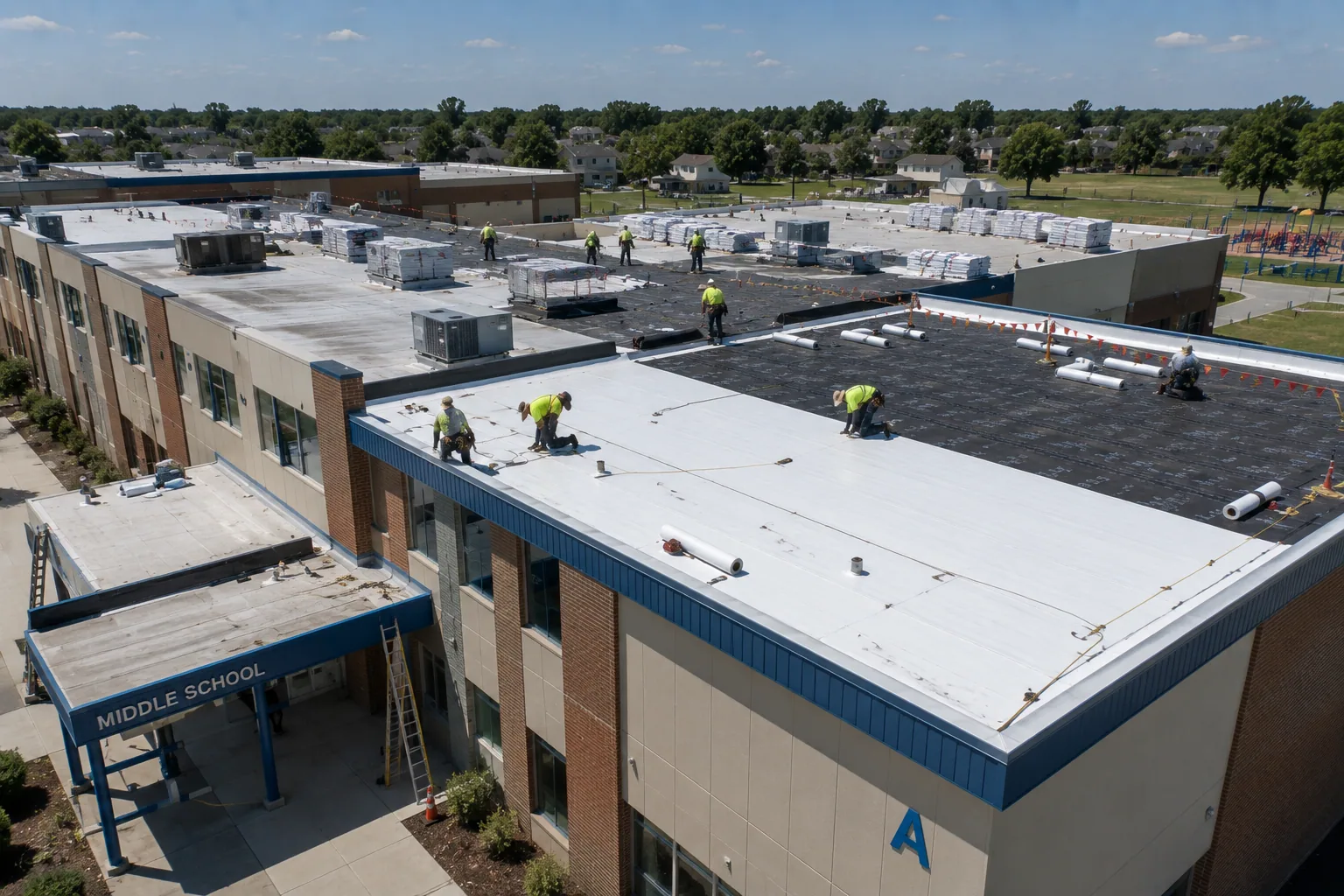

Commercial Roofing in Fort Mill, SC
A stained ceiling tile beneath a rooftop unit on an office building sends an owner in Fort Mill, SC to the roof, and the cause is more often the curb, the flashing or the drain than the membrane. Fort Mill grew from 10,811 residents in 2010 to 24,521 in 2020, with a 2025 estimate of 38,673. I-77 passes through the western part of town at exit 85, and SC 160 is the main east-west street. Employers include LPL Financial, Continental Tire, Schaeffler, Red Ventures, Daimler Trucks North America and Springs Industries.
A town with that mix has office, industrial and warehouse-style roofs side by side, and each needs a different first walk. The result is a photo log, a written list of what we found and a price for acting now against waiting.
Walk Office Roofs Unit by Unit
On an office roof the load is rooftop equipment. Each unit is checked along with its curb, its counterflashing, the condensate discharge and the membrane at the base. Then come the drains and the seams between units, because water that ponds between curbs works on both. Every finding goes into the photo log with a position on the plan.
Tenant changes add penetrations. A new unit, a new exhaust line or a new antenna each cuts the membrane once, and the flashing is only as good as the hour it was done. The log lists every penetration and rates it, so the owner knows which have been repaired and which have not. When a mechanical contractor is due on the roof, the roofer sees the plan first, and a curb gets flashed once.
Condensate lines get a look too. A discharge that lands on the membrane stains and wears it, and the fix is usually a pad, a drain connection or a longer run, all of which cost far less than the patch that follows.
Parapets and screen walls get the same attention on an office building. A screen added after the roof went down is held by posts that pass through the membrane, and each post base is a flashing someone had to get right. We photograph the base of every post, rate the sealant and note whether the screen is held mechanically or by sealant alone. Sealant by itself moves with the heat and fails first, so it goes on the list with a price.
Read Industrial Roofs Differently
Plants and warehouse-style buildings carry different loads. A production roof holds exhaust, make-up air and process equipment, and heat or residue near an outlet wears the membrane first. A warehouse roof covers a large area with few outlets, and a pond can hold for days. We log both conditions with photographs and depths.
The cost of a leak differs as well. Over an office it is a ceiling and a tenant complaint. Over a production line or racked inventory it is downtime or a claim. The scope puts the sections over the most sensitive space first, and the phasing plan keeps docks, lanes and equipment protected while the work goes on. Whatever a given employer runs under its roof, the log dates each change to racking or equipment, so the owner can see when the risk moved.
Roof drains on a long, flat industrial building carry the whole roof. When a strainer packs with leaves or windblown trash, water backs across the field and leans on every seam it touches. We lift the strainers, flush the lines, photograph the water line after the next rain and record how long the pond stayed. That record tells the owner whether the answer is a cleaning schedule, a new outlet or a slope correction priced as its own line.
Track Fast Growth Through Warranties
A town that more than doubled in ten years has many young roofs. A young roof often carries a manufacturer warranty, and the warranty carries duties: inspections, prompt notice of leaks, approved repair materials. The first step is to read it and put the duties on a calendar. The second is to log every repair with the product, the date and photographs, so a claim has a file behind it.
New construction fails at details. Drains clogged with construction debris, curbs flashed in a hurry and penetrations sealed with caulk are the early finds, and a walk in the first years catches them while the installer can still be called back.
Records matter more on a young roof than on an old one. The file should hold the warranty, the installer's name, the completion date and any inspection reports. When those papers are missing, the findings summary says who to ask, and the roof still gets a walk, a core where the evidence calls for one and a baseline rating. A roof with a clean file is easier to sell, refinance or insure, and it is cheaper to maintain because the next crew starts from facts.
Budget for Heat and Rain
Charlotte, the metro core, has recorded 104 F highs, and Rock Hill, to the south, has a 106 F record. Roofs across this part of the Piedmont take heat and heavy rain far more than snow. Sealants dry out in summer, seams stiffen and the first hard storm finds the gap.
One curb corner resealed in spring is an afternoon's work; the same corner left open can mean wet insulation and a stained ceiling by autumn. Deferred items compound: a ponded corner, a lap lifting at one edge and an undated patch each look minor, and together they become one replacement. A repair this quarter and a replacement in four years is often the right answer, and the report says so when the roof supports it.
Check Long Edges Before the Next Storm Line
Large, light roofs lose their edges first. Plants and warehouse-style buildings along a highway corridor carry long runs of coping and edge metal, and a single loose run can peel a membrane back in the next gust. We photograph each run in spring, with fastener spacing and joint condition logged, so a weak run is fixed before the storm and not after it.
Gaston County took an EF-1 tornado in May 2024, so the regional wind record is fresh. After a severe storm the walk repeats, and the dated summary supports insurance claim documentation.
Decide Between Repair and Replacement With Numbers
Dry insulation and a failure that stays local point to a commercial roof repair. A tired surface over a sound, dry roof may take a recover. A wide wet area, or repairs that keep turning up in new places, puts replacement on the capital line. Cores and a scan sort the roof into one of those cases, and the drivers sit beside each option: area, access, deck condition, insulation, curb count and the time of year. The building office names the governing code edition before the scope is final.
Owners in Fort Mill may hold roofs in Rock Hill or Tega Cay. Rating all of them on the same scale sends the first capital dollar to the roof that needs it, and each condition report adds to one running history.
Commercial Roofing Questions
Do you work on multi-tenant office roofs?
Yes. Every unit and penetration is logged, each flashing is rated and the repairs are priced by detail.
Can a manufacturing roof be repaired while production runs?
Often. Equipment below is protected, the work goes in sections and each section is closed before the crew leaves.
How do we find which curb is leaking?
Trace from the stain outward. A scan marks wet insulation, and a core confirms it.
What goes in the written findings summary?
Photographs tied to a plan, a rating by roof area, prices by detail and a plain repair-or-replace answer, with the places we could not reach listed.
Which code edition applies on a roof in Fort Mill?
The one the local building office has adopted. It is confirmed before the scope is final and filed with the date.
Topic
Fort Mill
Roof Types
Low-slope and metal
Related Roofing Work
Roof Insurance Claim Documentation
Commercial Roof Repair