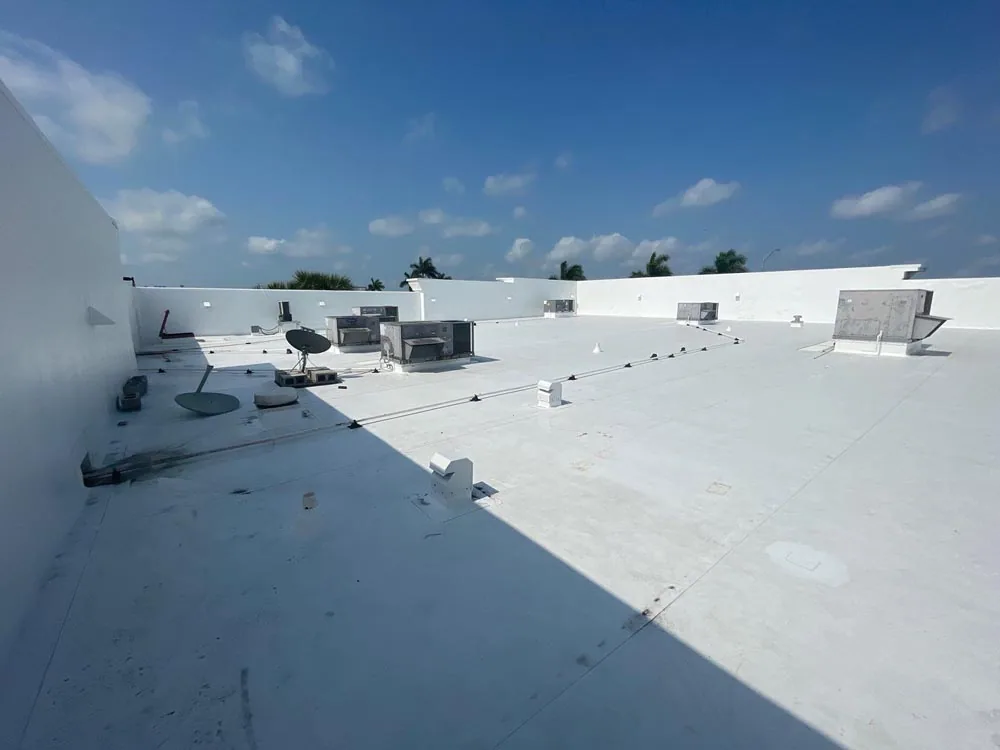
EPDM Roofing in Gastonia, NC
A black rubber roof with seam tape lifting at the edge of one sheet is a finding to expect on older low-slope buildings. Tape that has let go is not a crack in the rubber. It is a bond that has failed, and the sheet itself may have years left. What that means for the owner is a smaller bill, if the repair is made before water reaches the insulation.
On an EPDM roof in Gastonia, NC the walk produces a photo log of each finding and a written answer to the repair-or-replace question. A crew takes leak calls at night as well.
See how an EPDM roof is put together
EPDM is a rubber sheet, usually black, laid in large panels. The panels are joined with seam tape or splice adhesive, and the sheet is either adhered to the board, held by fasteners or ballasted with stone. The rubber itself is tough and flexible. The seams, the corners and the flashings are what fail.
On a walk we probe each seam, look for shrinkage that pulls the sheet away from walls and curbs, and check the pipe boots and corner patches. Rubber can shrink with age, leaving a bridged gap at the flashing. We photograph each finding and mark it on the plan, so the repair scope lists what is actually wrong instead of guessing.
Attachment changes the walk. A fully adhered sheet shows a bad bond as a soft blister. A mechanically attached sheet shows back-out as a ridge. A ballasted roof shows displaced stone near edges as a wind finding, and loose ballast can also clog drains. Each has its own repair, and the plan names the one the roof has, so the scope is not written for the wrong system.
Pipe boots deserve a separate count. Rubber boots crack where sun hits them, and a roof with thirty penetrations has thirty boots to check. We photograph each, rate its condition and list the ones to replace now. A boot is one of the cheapest parts on a roof and one of the most common sources of a leak.
Weigh black rubber against Piedmont heat
Black absorbs heat: with July highs averaging 90.7 degrees in Gastonia, a dark membrane on a flat roof runs far hotter than the air. The heat moves the rubber, loosens adhesives and speeds the aging of tape. Annual precipitation of about 44 inches tests the seams from the other side. Snow averages only about 1.2 inches a year, so heat and rain drive the wear.
A white or reflective surface is an option. An EPDM roof can be coated or replaced with a lighter membrane when cooling cost is a concern. We lay out the comparison in a scope of work, with the cost of each path, so the decision date is clear.
Ponded water deserves its own line. Rubber tolerates standing water better than some membranes, but ponds still add weight, hold dirt and work on seams over time. We log every pond, measure depth where it matters and recommend drain fixes, tapered insulation or leaving it alone, depending on the cause and the budget cycle.
Count the cost of waiting
A strip of new seam tape is a small line item. Left alone, a lifted seam lets water into the insulation with every storm. Wet insulation has to come out, and the repair becomes a section of roof. The same pattern holds at a shrunken flashing: a bead of sealant is cheap, a wet wall cavity is not.
Three numbers go side by side: repair this quarter, a limited repair that holds a year, or replacement on a set decision date. Wet insulation, access, penetrations, flashing work and the system chosen set the price. The photo log shows which stage the roof has reached, and the owner chooses with the facts on paper.
A rubber roof's remaining service life belongs on the capital line with a year beside it. Where years remain, upkeep keeps them. Where the sheet is close to done, replacement is priced early enough to compare bids. In between, a limited repair fits, and a repeat finding on the next walk moves the replacement date up.
Decide repair or replace
Repair when the insulation is dry and the failures are seams and flashings. Fresh tape, a new splice and rebuilt boots can buy years, and commercial roof repair fits when the rubber is still pliable. A coating restoration can extend a sound sheet that has surface wear.
Replace when the rubber is brittle, cracked or shrunk past repair, or when the insulation is wet across a wide area. A new roof may be EPDM again, or TPO if a lighter color and welded seams suit the building. A core cut and moisture survey guide the choice, and the answer goes in writing.
Next to a plain modified bitumen roof, rubber is lighter and simpler to repair, but it depends more on tape and adhesive, which age under heat. We say so, and we list the maintenance a rubber roof needs: clear drains, a seam check each spring and photographs of the flashings. A maintenance program keeps the photo log current and the next decision date visible, so a lifted splice is caught as a line item.
Check the older Gaston County buildings
Gaston County's mill heritage means old roofs. Belmont's downtown historic district has 264 buildings dating from 1850 to 1949, and Gaston County's oldest surviving mill is the Mount Holly Cotton Mill, which was begun in 1875. We do not assume what is on any of them. Small, low-slope roofs on older commercial buildings are where EPDM is often found, and they are read one at a time.
The retail strip around Eastridge Mall on North New Hope Road and the Belmont downtown each call for the same first step: probe the seams, photograph the flashings and ask what the last repair was.
Storm records give context. Tornadoes have crossed the county twice in recent years: an EF-1 on May 8, 2024 with estimated 110 mph winds, and a May 2020 storm with 85 mph winds that ran roughly 8.7 miles toward the Gastonia airport. After a hard storm, we check the perimeter, the corners and every flashing, since wind starts at the edge and a ballasted or adhered sheet can lift there.
Commercial Roofing Questions
What fails first on an EPDM roof?
Seams, corners and flashings, not the rubber itself. Tape lifts, boots crack and the sheet shrinks away from walls. We probe each detail and log it on a plan.
Can seam tape be replaced without replacing the roof?
Often yes, if the rubber is clean and pliable and the insulation is dry. We test the area first, repair the lap and probe the neighbors for the same problem.
Does a black roof cost more to cool?
It can. A black membrane absorbs heat, and Gastonia's July mean high is 90.7 degrees. A coating or a lighter replacement membrane are options, priced against the remaining life.
Can EPDM be recovered?
Sometimes. The old sheet must be dry underneath and sound enough to carry a new layer. A core cut and a moisture survey tell us before we price it.
What should I send before you visit?
Send the roof age, how the building is used, any leaks and past repair invoices. You get a written findings summary that answers repair or replace in plain words.
Topic
EPDM Roofing
Roof Types
Low-slope and metal
Related Roofing Work
Commercial Roof Repair
Roof Coating and Restoration