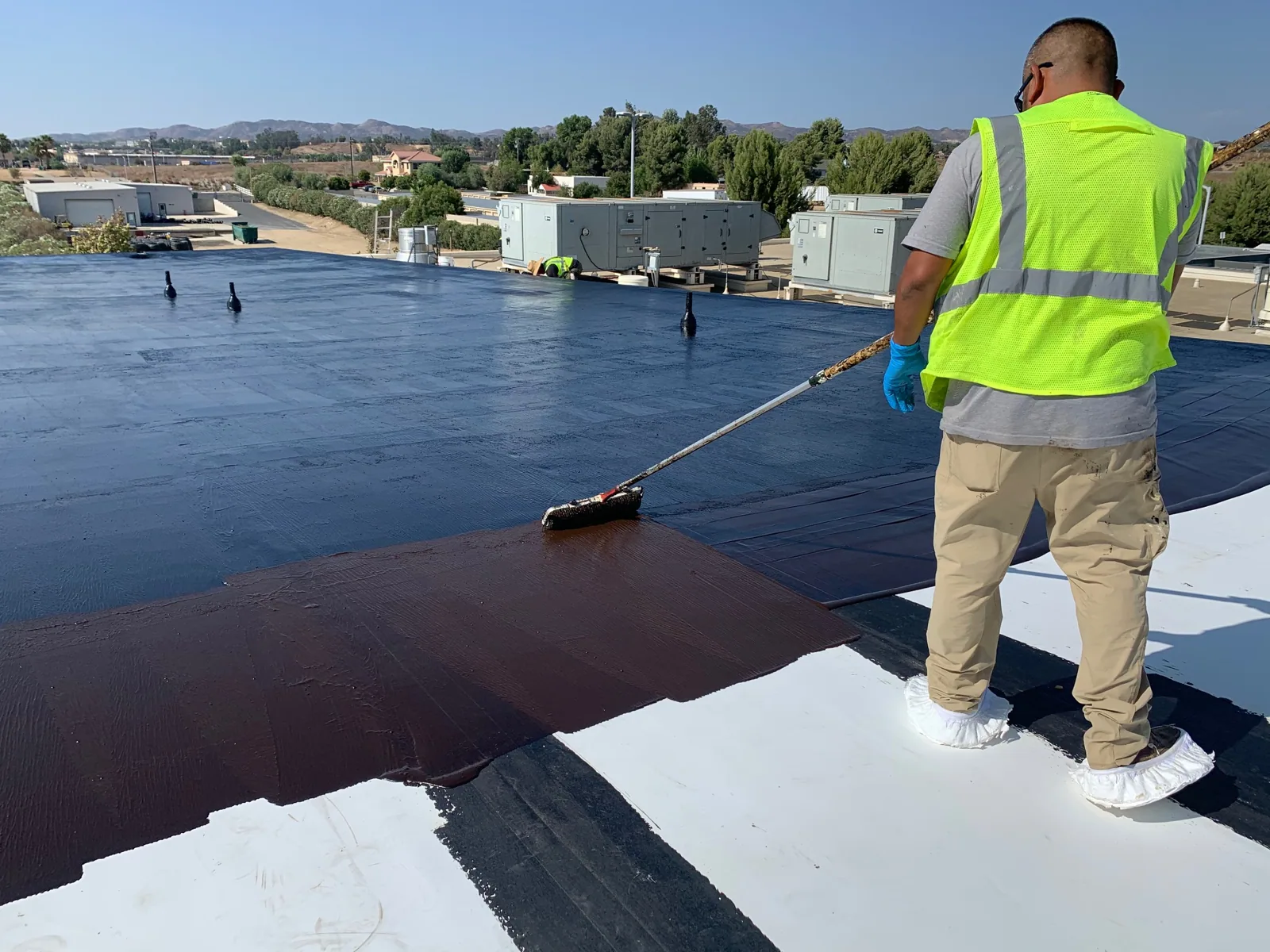

Modified Bitumen Roofing in Gastonia, NC
Bare black patches where the granule surface has worn away, and a lap that has opened a finger-width along a parapet, are what a roofer sees on a modified bitumen roof that has been in the Piedmont sun for a long time. The bare patches are the sheet losing its sunscreen. What that means for the owner is a decision date: coat or recover now, while the layers underneath are still sound, or replace when water gets in.
Modified bitumen roofs in Gastonia, NC are cored, logged in photographs and answered in writing as repair, recover or replace. A roof leaking on a Sunday night still reaches a crew.
See how the sheet is built
Modified bitumen is asphalt blended with a polymer, SBS for flexibility or APP for heat stability, reinforced with a fabric mat and usually surfaced with mineral granules. The sheets are laid in two or more plies and joined at the laps by heat, torch, hot mopping or cold adhesive, and some are self-adhered. The granules shield the asphalt from sun.
On a walk we look at the granule surface, the laps, the flashings and the field. Bare spots, cracks at the laps, blisters, splits over deck joints and open flashings are the findings. We press blisters, probe laps and log each in a photo log, with a plan that shows where the sheet is sound and where it is not.
Flashings on bitumen roofs are built differently from the field. Base flashings turn up the wall and are covered by a counterflashing or a termination bar, and the cap sheet laps over them. Cracks at the turn, split corners and open terminations are the common findings. A roof can be sound across the field and failing at every wall, and the photo log shows which one we are looking at.
Surfacing wears unevenly. A cap sheet that has lost granules along an open parapet ages faster than the sheet in the shade of a unit, so the walk compares the two and records where the loss is heaviest.
Respect the old mill roof
No county in the country once ran more cotton spindles than Gaston County, and the five-story Loray Mill, built in 1900, is among the legacy mills now turning into apartments and mixed use. A mill that has been roofed more than once can carry several layers of bitumen from different decades.
Those layers matter for the decision. A core cut shows how many there are and whether they are wet. A mill-era roof with five layers and a wet bottom layer needs tear-off. One with a dry base may take a recover. Torch work on an old building is a fire risk, so cold-applied and self-adhered systems are often the safer repair method, and we say so in the scope.
Mill buildings add their own details. Monitor roofs, skylights, tall parapets and old penetrations for belts and shafts all create flashing work. Abandoned openings are common and are found by looking for patches and plugs that do not match the original roof. We list each and recommend sealing or removing the ones that no longer serve, because a hole the owner forgot is a leak the owner will find.
Price the cost of waiting
A coating over a sound, dry bitumen roof is a modest line item and can buy years. A recover is a larger one. A tear-off and replacement is the largest, and the cost goes up if the insulation is wet. The longer a bare or cracked roof waits, the more likely a spring storm drives water through the cracks and turns the cheap choice into the expensive one.
July highs near 90.7 degrees age the surface, and about 44 inches of precipitation a year finds the cracks. Repair, coat, recover and replace go side by side, each with a decision date, and the cost drivers are named: wet insulation, access, layers and edge metal.
Asphalt layers tell their own age. Sound layers under a worn surface can be protected and kept in service. Layers at the end of their run need replacement priced with room to compare bids and choose a season. The middle ground gets a limited repair, and the following walk shows whether replacement moves up. A core taken at the same spot each visit makes that comparison concrete, since the ply count and moisture reading are written beside the date.
A maintenance program is the cheapest line on the list. Two walks a year clear drains, reseal small lap openings and photograph the granule surface, and the photo log shows when wear moves from cosmetic to structural. Owners who keep that log can answer a lender's question about remaining service life with pictures instead of opinions.
Decide repair or replace
Repair when the failures are local and the insulation is dry. Patching a lap, rebuilding a flashing or replacing a section can add years, and commercial roof repair is the tool for that. A coating restoration can protect a sound sheet that has lost granules. Recover when the base is dry and firm.
Replace when moisture has spread or the sheet has split across the field. A new roof may be modified bitumen again, or a single-ply such as TPO or a built-up system, depending on traffic, exposure and budget. Cores and a moisture survey support the choice, and the answer is written down.
Weather sets the calendar. Cold-applied systems need workable temperatures, and Piedmont spring storm season can interrupt an open roof. We size each day's work so every section is closed in before dark and order materials early. Hurricane Hugo's 87 mph gusts at Charlotte on September 22, 1989 show that remnant tropical systems can bring damaging wind this far inland, so temporary protection stays ready whenever the forecast turns.
Check Gaston County's older roofs
The FUSE District is a 16-acre downtown redevelopment centered at South Hill Street and West Franklin Boulevard, and nearby projects include the Trenton Mill redevelopment. Belmont put up nearly twenty mills through 1930 and many are gone or converted, most of Ranlo's mills have closed, and Cramerton's Eagle Mountain Finishers and Lakewood Dyed Yarns closures left former textile buildings.
A converted mill, a vacant mill and an occupied plant can each carry bitumen, and each calls for a different first step. A walk in downtown Gastonia or in Cramerton starts the same way: probe, core and photograph.
Commercial Roofing Questions
What does granule loss mean on a bitumen roof?
The surface that shields the asphalt from sun is wearing away. Bare patches age faster. A coating or recover can protect a sound roof, but only if the layers underneath are dry.
Is torch work safe on an old mill roof?
It carries fire risk. On older buildings we often use cold-applied or self-adhered repairs. Fire watch, extinguishers and permit rules are agreed before any heat work.
What is the difference between SBS and APP?
SBS is rubberized and flexible, APP is plastic-modified and more heat tolerant. Both are modified asphalt. The right one depends on the building, the deck and the repair method.
Can I recover over modified bitumen?
Sometimes. The base must be dry and firm. Cores and a moisture survey tell us first, and the answer goes in writing.
What should I gather before a walk?
Gather the roof age, the building use, leak history and repair invoices. The written findings come back with repair or replace answered plainly.
Topic
Modified Bitumen Roofing
Roof Types
Low-slope and metal
Related Roofing Work
Preventive Roof Maintenance
Commercial Roof Repair