
Commercial Roofing in Cherryville, NC
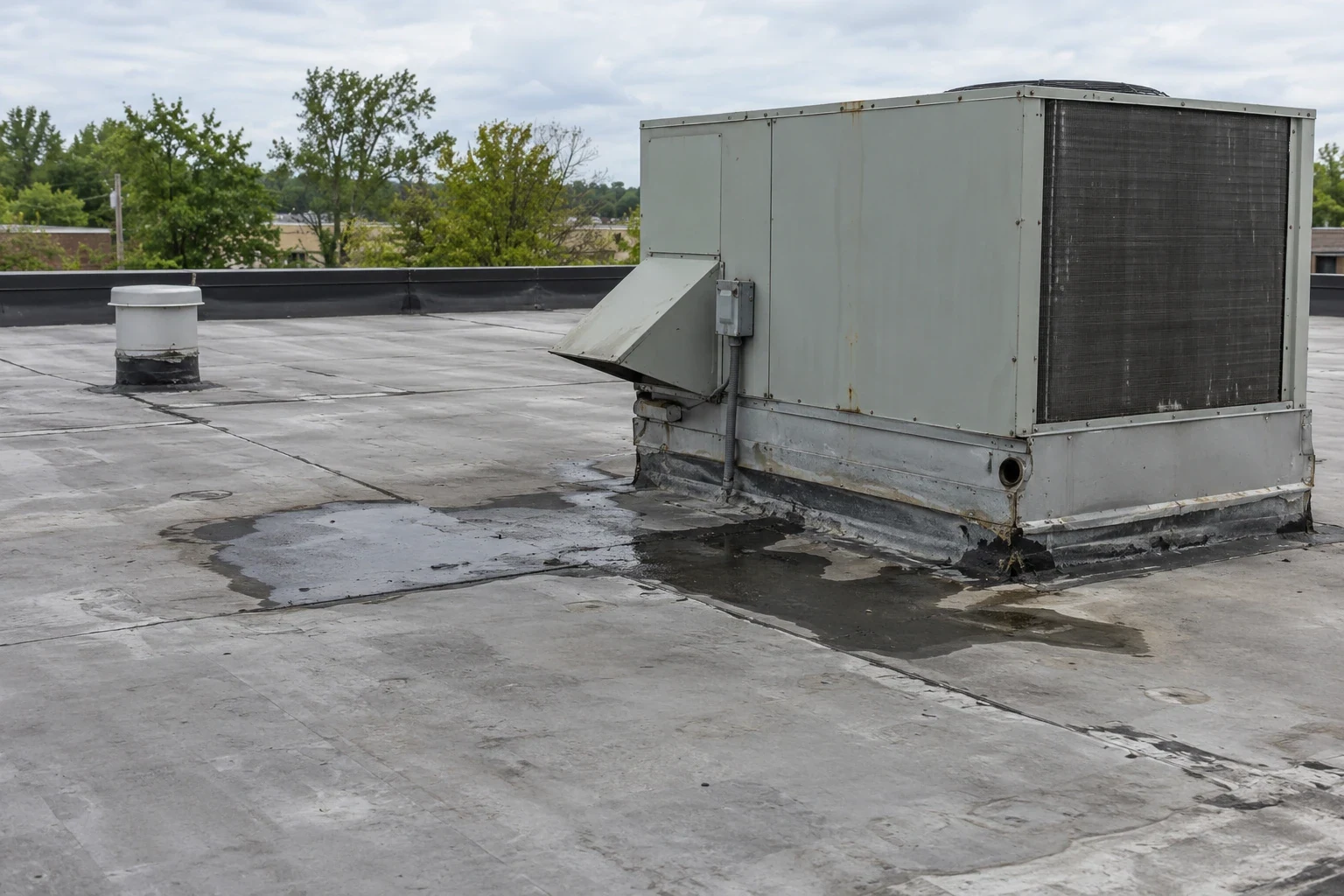
Old patches stacked three deep beside a rooftop exhaust fan are the finding we look for first on a manufacturing roof in Cherryville, NC, and they tell an owner that the same corner has failed more than once. Cherryville sits about 16 miles northwest of Gastonia. All 13 of its former textile mills have closed, and current manufacturing includes automotive powdered-metal parts, furniture, modular homes and polyurethane products. A roof over a production floor ages differently from one over a warehouse, because exhaust, heat and equipment add load to the membrane.
We walk it, photograph what repeats and price the permanent fix against another patch.
A plant roof budget competes with equipment, payroll and inventory. That is why the findings are short, priced and dated. An owner can read them in ten minutes and decide.
Walk the Equipment Before the Field
On a plant roof we start where the load is: exhaust fans, make-up air units, vents and pipe supports. We check each curb, the counterflashing and the membrane around the outlet, then probe the nearest seams and look for ponding between units. The field comes next, with drains and scuppers last.
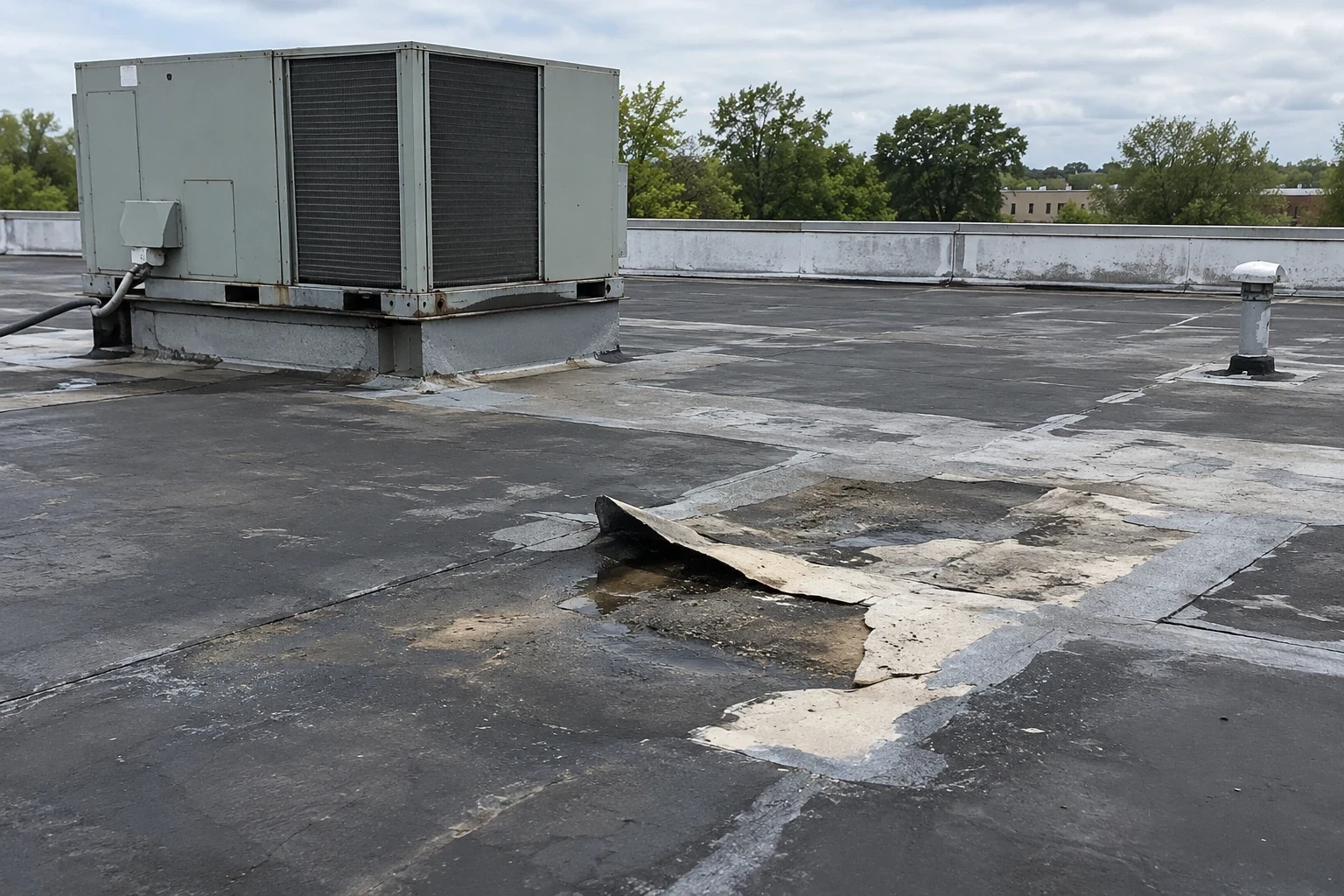
The order matters because equipment is where roofs fail first. A curb that has moved with vibration tears the flashing a little more each season, and a patch over a tear is the cheapest repair that lasts the least. The photo log shows each unit and its flashing, and a unit with three patches gets a rebuild, not a fourth.
A repair that keeps recurring is itself a finding, and the log records it.
A roof record lists each unit, its curb and the date of its last flashing repair, and that is how an owner sees which unit is expensive.
Roof hatches and ladders on a plant see more traffic than the roof itself, because maintenance staff climb up to change filters and clear belts on the exhaust fans. We look at the hatch gasket, the ladder fastening and the worn path across the membrane between the hatch and the first unit. A walk pad costs little against a patched path, and the plan marks where it should go so the next service call uses the same route. The note also records who holds the key, since a locked hatch on a Saturday leak call costs the first hour.
Count the Cost of Heat and Residue
In the Gastonia record, July averages 90.7 F and snow barely reaches an inch a year, so heat, not snow, is the steady load, with about 44 inches of rain behind it. A plant adds to it. Process exhaust can soften or stain a membrane near the outlet, and sealants harden faster in a hot spot.
We log discoloration, softening and residue around outlets, and we price protection. A wear pad, a diverter or a relocated outlet can be cheaper than repeated membrane repairs. The owner sees both numbers and the interval between repairs, which is the real measure.
A repair that lasts one season is a loan, not a fix.
Furniture and modular-home production, which the town lists among its current manufacturing, can involve dust, heat and process air. Whether any one plant leaves residue is a question the roof answers, so we look for it and log what we see, with photographs.
Treat Former Mill Buildings as Unknown Until Cored
Cherryville's textile past is closed, but the buildings that served it may still stand in some form. If an owner has a building from that era, a core shows the deck, the insulation and the layers of past repairs, and a moisture scan shows where water has gone. Older flat roofs are often layered, and the layers decide whether a recover is allowed or a tear-off is needed.
The cost of finding out is small. The cost of not finding out shows up at tear-off, when a wet layer or a failed deck changes the price. We write the finding before the quote, so the owner sees the risk while the scope is still open.
If a building has been converted or divided, the roof usually shows it. Different sections carry different ages, materials and slopes, and the joints between them are where leaks start. We mark each section on the plan and rate it separately, so a good section does not hide a bad one.
Check Edges Before the Spring Storms
The May 2024 EF-1 tornado that cost an East Gastonia warehouse part of its roof is a reason to check edges before storm season, sixteen miles away or not. We look at coping, drip edge and corner metal, and at rooftop covers that could lift.
After a severe storm we walk again and send a dated summary. The photographs support insurance claim documentation, and they show what the roof looked like on the day.
Equipment covers and louvers are the first things to lift in a gust. We check latches, hinges and tie-downs, and we photograph anything loose. Fixing a latch costs a few minutes on a roof visit. Replacing a cover that blew across the roof, and the membrane it tore, costs a day.
Choose Between Repair and Replacement on Evidence
Repair fits a local failure on a roof that is otherwise dry. Replacement fits a roof with a wide wet area, failing seams across the field or a repair history that costs nearly as much as a new roof. A leak repair that follows a trace fixes the entry point. A replacement should arrive on a date the owner picked.
For a plant, phasing is part of the price. Sections close the same day, equipment below is covered and noisy lifts avoid peak production. The cost drivers are listed beside each option.
Deferred repair is how a small item becomes a budget surprise. A drain that holds water after every storm, a seam that has opened a quarter inch and a patch from three owners ago each look small. Together they are a replacement. The written summary lays the items side by side and gives a decision date.
Plan Across NC 274 and the Neighboring Towns
Cherryville had 6,078 residents in 2020. Large employers include FleetNet America, with over 375 employees, Keystone Powdered Metal, with 220, and Bradington-Young Furniture, with 187, and NC 274, called Mountain Street in town, is the main highway. An owner with buildings in Cherryville may also hold roofs in Kings Mountain or Lincolnton. We rate them on one scale, so the capital line goes to the roof that needs it first.
The scope is not final until the building office confirms which edition of the state code applies.
Access closes the loop. We agree on the hatch or ladder, who holds the key, which units must keep running and where the crew can stage materials. Deliveries, shifts and fire lanes are listed in the work order, and a named contact approves changes if the crew finds hidden damage.
Commercial Roofing Questions
Do you work on manufacturing roofs while plants run?
Usually. We protect equipment below, work in sections and close each before we leave.
Why do the same spots keep leaking?
A curb, corner or seam is failing for a reason that patches do not remove. The photo log shows the pattern.
Can an old mill-era roof be recovered?
If it is dry, sound and within code limits for layers. Cores and a scan confirm it.
What does a written findings summary include?
Photographs, a rating for each roof area, a repair list with prices and the repair-or-replace answer.
Can you price the cost of waiting?
We show the repair price this quarter beside the likely price after another season, with the gap spelled out.
Topic
Cherryville
Roof Types
Low-slope and metal
Related Roofing Work
Roof Asset Management
Roof Insurance Claim Documentation