College and University Roofing in Gastonia, NC
Walk a campus roof by roof and you will find a different story on every building. A science hall with a patched flat roof, a residence hall with tired flashing at its parapets, a library with a drain that never quite empties. None of it is unusual. What matters to the owner is that a college can hold many roofs on a single budget, and the roofs do not wear out in the order the budget expects.
In Gastonia, NC, hot summers near 91 F and about 44 inches of rain a year work on every one of them. We inspect campus roofs section by section and write up what we found in a form a facilities office can rank: which roofs to repair this year, which to schedule, and which to replace. The report is built so that a vice president for finance can read it without a roofing background. A school roof and a college roof share the same physics, but a college adds research space, residence halls, and event venues that change what a leak costs and who has to be told.
Rank Every Roof by What It Costs to Wait
A campus capital plan needs a ranked list, not a pile of reports. We rate each roof section on a common scale: dry or wet insulation, seam and flashing condition, ponded water, and remaining service life. The result is a list that puts a leaking lab roof ahead of a sound dormitory roof, whatever their ages. Ratings use the same words for every building, so a roof walked in March and another walked in July can be compared without guessing. Deferred repair on the roofs at the top of the list costs the most, because water travels, and the interior damage below is often the larger bill.
Each rating comes with a photo log and a repair price. A facilities director can set the worst roofs against the budget and see what can be funded this cycle.
Sort Old Buildings from New Ones
Gaston College has its main campus on US 321 near Dallas and a Kimbrell campus in Belmont, and Belmont Abbey College sits in the same town as a downtown historic district with 264 buildings from 1850 to 1949. A campus can hold a similar mix of older masonry and newer construction, and the roofs follow suit. An older building may have parapets, through-wall flashing, and a roof that has been patched many times. A newer one may have a single-ply membrane with long seams and rooftop units.
We walk each roof, read its layers, and record the system. The repairs and the schedule follow from that reading, and the report names what each building has. For the older masonry buildings, the first checks are the parapet cap, the through-wall flashing, and the mortar joints above the roofline, since water that gets behind a parapet shows up inside as a stain far from its entry. For the newer ones, the first checks are seams, fasteners, and the flashing around rooftop units. The two lists are different, and the walk follows each.
Fix Ponded Water Before It Fixes Itself
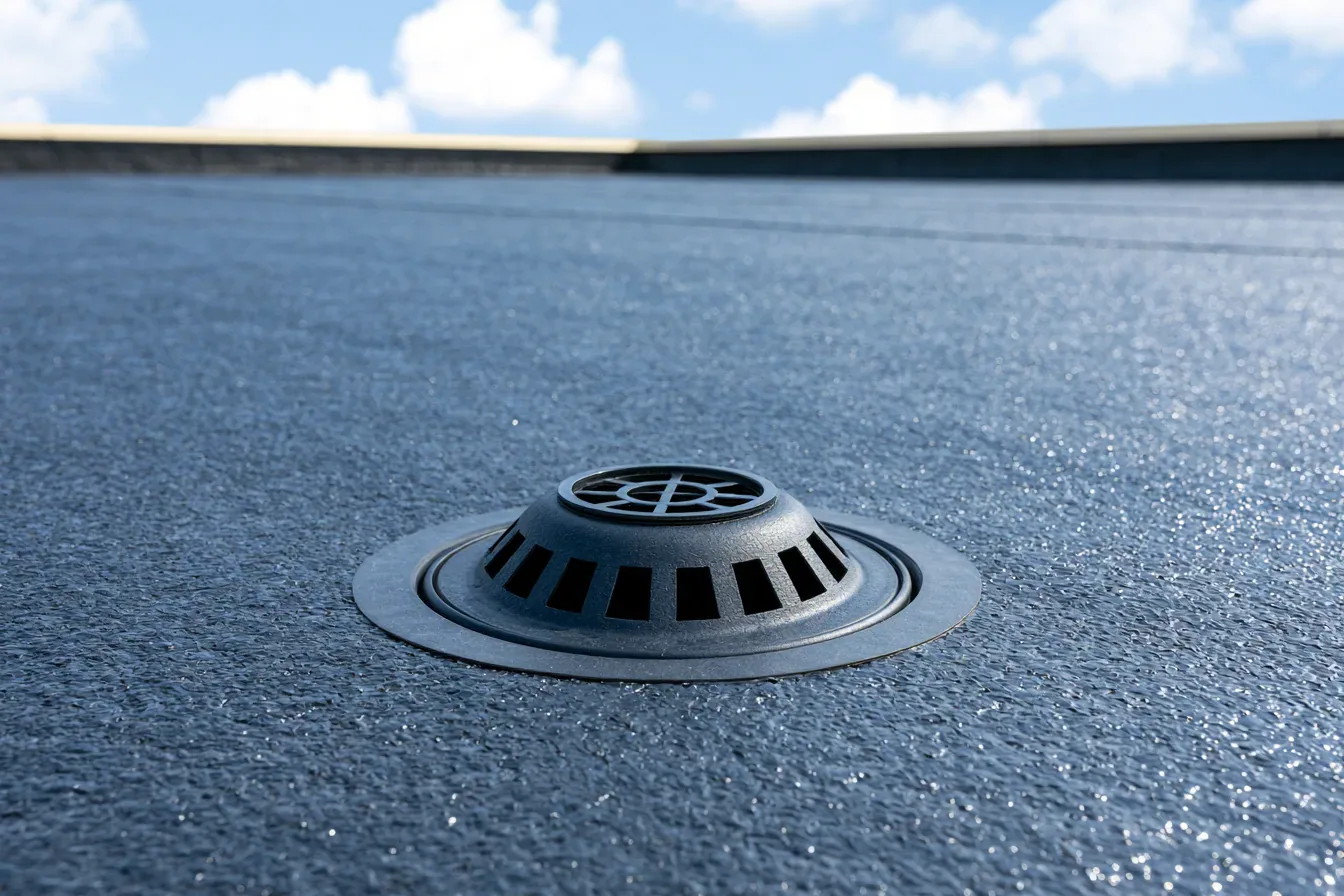
Ponded water is a frequent finding on flat campus roofs. A drain that sits slightly high, or a deck that has deflected, holds water for days. Standing water ages the membrane, adds weight, and finds every weak seam. We measure how long it stays, clean the drains, and look at the cause. Cleaning is often enough. When it is not, tapered insulation or an added drain corrects the slope.
The ponding water repair is priced as its own item, so the budget shows what the drainage fix costs apart from the membrane. A drain problem left alone for a year usually costs more than a drain problem fixed this month. The same walk finds drains and scuppers buried under leaf litter, and a spring cleaning of those on every campus roof is the cheapest line in the budget. Where a drain cannot be reached safely, the report says so, and the fix is a fall protection tie-off point, not a guess from the ground.
Residence halls and labs are walked in different weeks from the library, so the crew does not stack disruptions on one corner of campus. The ranking shows which building's roof is next.
Schedule Work Around Terms and Breaks
Campus roof work belongs in summer and between terms, when residence halls and classrooms are empty. A roof over an occupied lecture hall or a lab with sensitive equipment needs a plan for noise, dust, and temporary protection. We list the buildings that can be done in a summer and the ones that need a phased plan. A phased plan might put the lab roof into a short winter break and the dormitory into summer.
Crane days and material staging need campus approval, so the schedule includes time for facilities and security to review routes. When a building cannot close, occupied building reroofing methods guide the sequence, and a warehouse-style storage building on the same campus usually goes first because it has no one to disturb.
Walk the Roofs After a Storm Line
Gaston County took an EF-1 tornado on May 8, 2024, and a smaller one in May 2020 whose track ended near the Gastonia airport. Spring storms with damaging wind reach this area, and a campus with many roofs should walk them after a storm for lifted edges, loose coping, and displaced equipment.
Dated photographs of each roof tie damage to a storm and separate it from wear. That record helps with an insurance claim, and it helps the board see what the policy should respond to. If a storm does cause damage, temporary protection goes on first, and the permanent repair follows once the carrier and the facilities office agree on scope.
Turn Findings into a Capital Line
The final piece is the budget. We turn the ranked list into a multi-year plan with a line for each roof: repair now, coat later, replace by a stated year. A roof capital plan lets a college set aside money in the right years instead of finding it in an emergency. Facilities offices that keep a record of past repairs can add it to the file, and we add ours. Each line carries a decision date, such as the budget meeting where the money has to be committed, so the roof plan moves with the calendar and nothing is decided by default. A roof that reaches its decision date unreviewed is usually repaired in an emergency, and an emergency costs more than a plan. Campuses near Gastonia Technology Park or the downtown core get the same format.
Commercial Roofing Questions
Can you inspect all campus roofs in one visit?
Depending on size, in a few visits. We schedule around classes and give a single report with the roofs ranked.
What if a building is occupied during repairs?
We plan noise hours, protect the interior, and keep the work zone fenced. Sensitive rooms are listed before work starts.
How do you estimate remaining life?
From core cuts, moisture scans, and condition. We state a range and explain what moves it up or down, such as a new leak, a failed flashing, or a year of ponded water.
Do you work with campus facilities contractors?
Yes. We coordinate with mechanical and electrical trades whenever a unit or conduit crosses the roof.
Can the report support a grant or bond request?
It can. The photo log, condition ratings, and repair prices give reviewers a concrete basis for the request.
Topic
College and University Roofing
Roof Types
Low-slope and metal

Related Roofing Work
School Roofing
Ponding Water Roof Repair