Government and Municipal Building Roofing in Gastonia, NC
A public building's roof often waits for the next budget cycle. The finding a roofer sees is a flat roof with a patch from three administrations ago, ponded water at a drain nobody owns, and a ceiling tile that facilities staff replace every spring. What that means for a public owner is a budget cycle problem: the repair is small this year, the replacement is large, and a council or commission has to be shown why both numbers are real.
The City of Gastonia, Gaston County government, and Gaston County Schools are among the major employers in Gastonia, NC, and each owns buildings that serve the public every day. Those roofs work through July heat near 91 F, steady rain and a spring wind season that produced the May 2024 EF-1 tornado. We walk the roof, photograph what we find, and write the findings in the form a public body can use: clear, dated, and priced.
Write Findings a Council Can Read
A commission member does not need roofing vocabulary. They need to know what is wrong, what it costs to fix, what happens if the work waits, and when the decision is due. Our report states each finding in a short sentence, shows a photograph, and places it on a plan. It ranks the roofs by urgency, so the building with active leaks sits ahead of the building with a sound roof and an old date.
The report also separates repair items from capital items. Repairs may fit an operating budget. Replacements need capital funding, and the report gives the figure and the timing. A campus owner uses the same ranked list to spread spending, and a public body can borrow the format without change. The report is dated, signed off by the person who walked the roof, and written so that an auditor, a new commissioner, or a successor in the facilities office can read it a year later and still follow it.
Prepare a Scope That Survives Procurement
Public work usually goes through a formal bid or quotation process. A roof scope has to be clear enough that bidders price the same work. We write scopes that name the existing roof system, the extent of the work, the materials, the attachment, the flashing details, and the warranty terms. We also identify what is excluded, such as asbestos or structural repair, so surprises do not appear after award.
When the owner requests it, we provide core-cut results and moisture data as attachments, so bidders can see what is under the roof. A clear scope gives the public owner better pricing and fewer change orders. We also note allowances: a unit price for replacing wet insulation, for example, so that if the cores understate the problem, the cost of the extra is already agreed. That keeps a change from becoming a dispute, and it keeps the project inside the approved budget more often than a lump sum with no unit prices.
Allowances are written with a unit and an expected quantity, so the cost of a change is known before the first tear-off and the board does not meet twice to approve it.
Keep the Public Served During the Work
A courthouse, a police station, a library, and a recreation center each need to stay open in a different way. We map the work around public hours, secure areas, and records or evidence spaces that cannot get wet. Access for the crew is cleared with building security. Noisy steps are scheduled when the least sensitive spaces are below. Roof sections are dried in by evening, and the daily log shows the facilities director what was opened and closed. Records rooms, server closets, and evidence storage are marked on the plan before the work starts, with a protection method for each. A temporary cover goes over any opening before the crew leaves. If a public meeting or an election day falls in the work window, the schedule moves around it.
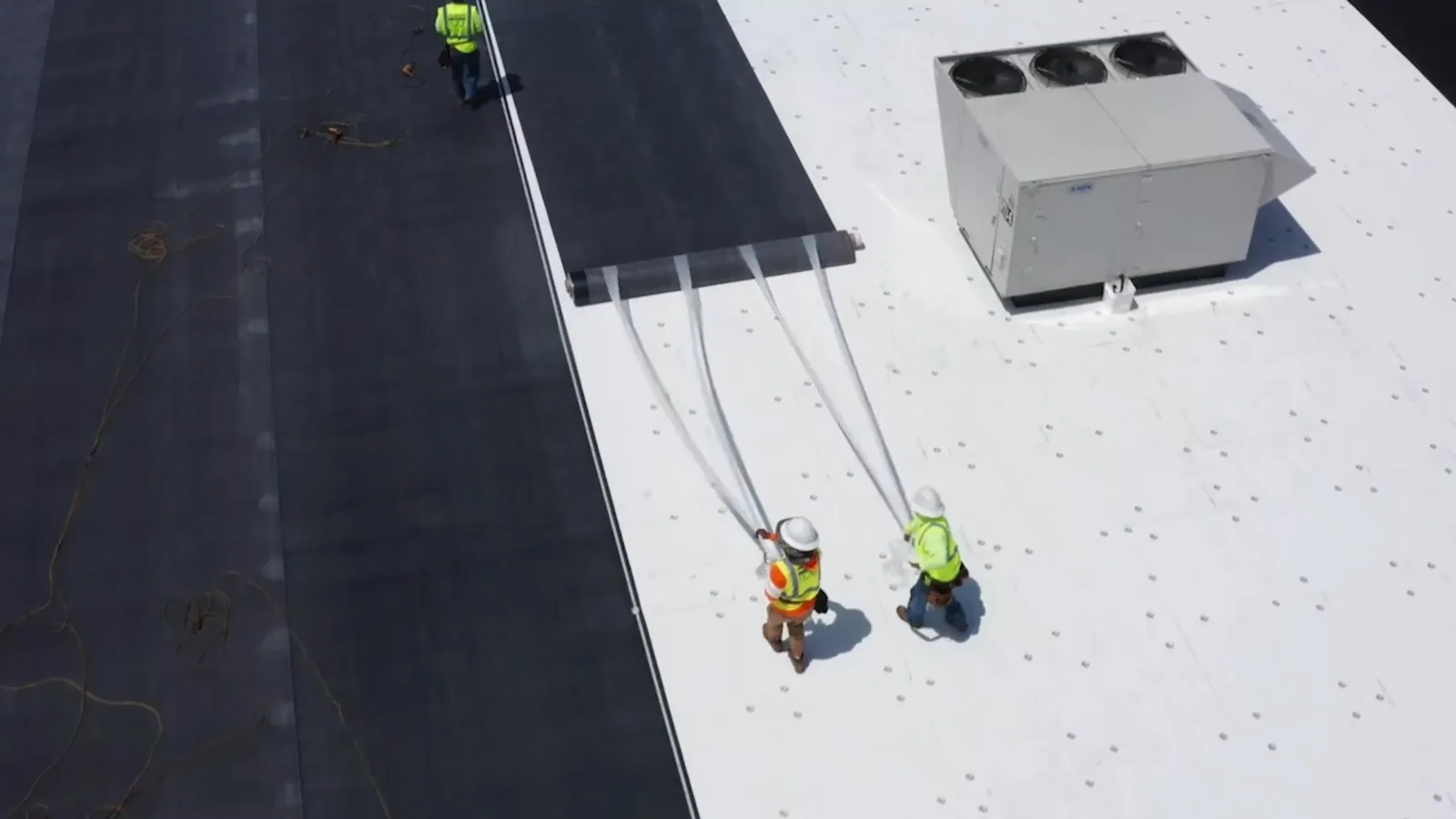
Our occupied building reroofing sequence is built to keep service running.
Respect Older Public Buildings
Older civic buildings have parapets, masonry walls, and roofs with a long patch history. The city has sought developers for a roughly 70-year-old former National Guard armory in the FUSE District, a reminder that older public properties raise questions about roofs and reuse. On old civic masonry the caps, the through-wall flashing and the mortar above the roofline come first, since water behind a parapet shows up indoors far from where it entered. When a building is on a historic register, the repair has to respect its materials, and we ask about that before pricing. Older public buildings may also have asbestos-containing materials in roofing or flashing, which affects the scope and the schedule. We flag the possibility, recommend testing before demolition, and leave testing and abatement to licensed specialists. Finding out early costs little. Finding out in the middle of a tear-off stops the job and the budget with it.
Choose Between Repair, Recover, and Replacement
Dry insulation under a sound membrane points to repair. One with a worn surface but dry insulation may take a coating restoration or a recover. One with wet insulation across large areas needs replacement. An infrared moisture survey and core cuts decide. The scope waits on the building department's answer about the governing code edition. The cost drivers for a public roof are the area, the amount of wet insulation, the number of penetrations, the access around an occupied site, and the protection needed for sensitive rooms. We list each driver with its own price, so a commission can see what moves the total and decide whether to fund the whole project or a first phase.
Keep Records for Storms and Audits
Two tornadoes have crossed Gaston County in recent springs, the EF-1 of May 8, 2024 and a smaller storm in May 2020. After a storm, we walk public roofs and photograph the edges, equipment, and flashing. The record supports an insurance claim and answers an auditor's question about what was known. Where a county, a school system, and a city each own buildings in the same area, the same photo log and rating scale let each body compare its roofs on equal terms. Dates matter: a roof walked in March and again in September shows what the summer did, and that difference is the best argument for a repair budget. Owners in Gastonia, Belmont, and Mount Holly get the same format, and a National Guard armory follows federal and state rules in addition.
Commercial Roofing Questions
Do you write scopes for public bids?
We do. Each scope describes the existing roof, the work, materials, and exclusions clearly enough for consistent pricing.
How do you keep a courthouse or library open?
We coordinate with building security, work in sections, and schedule noisy steps for quiet hours.
What can a council expect to see in the report?
Photos, a ranked list, repair prices, and a replacement estimate with a decision date. The report is short enough to read in a meeting and detailed enough to defend an audit.
Can we phase work across budget years?
Phasing works well for public budgets. We rank sections and price each phase, so each year's work is complete and the roof stays dry.
What if the building is historic?
We check what the repair may change, and we match materials where required. A review by the historic commission or state office may be needed before work begins, and we build that time into the schedule.
Topic
Government and Municipal Building Roofing
Roof Types
Low-slope and metal
Related Roofing Work
College and University Roofing
Occupied Building Reroofing