

GAF Commercial Roofing Systems in Gastonia, NC
The warranty paperwork says GAF. The roof says something else: a modified bitumen cap sheet over an older built-up base, with a single-ply patch near a unit. A mismatch like that changes the repair. Before we price anything on a roof with a GAF name in the file, we find out what is actually on it.
In Gastonia, NC the question applies equally to a newer industrial building, an older mill-era building and the in-between buildings with additions. The answer decides whether the next dollar goes to a patch, a recover or a capital line, and whether the owner is paying for the right fix.
Know the Systems Behind the Name
GAF is a large roofing manufacturer whose commercial offerings cover single-ply membranes, modified bitumen and built-up materials, along with insulation, coatings and accessories. A roof carrying its name may therefore be any of those categories, and a building with additions can carry several.
We identify each area by core, label and installation record, and write the result on the roof plan. Where the records and the roof disagree, the report says so and relies on what we saw. The owner's warranty document governs what the manufacturer will accept. Our job is to document the roof so a decision can be made on facts.
Components matter as much as the sheet. Insulation board, cover board, edge metal, fasteners and sealants usually appear on a warranty as a set. When we repair or recover a roof, we match them to what the file lists, and we flag anything that differs, because a mismatched part is the first thing a reviewer questions.
Inspect Layered Asphalt Roofs for Their Weak Points
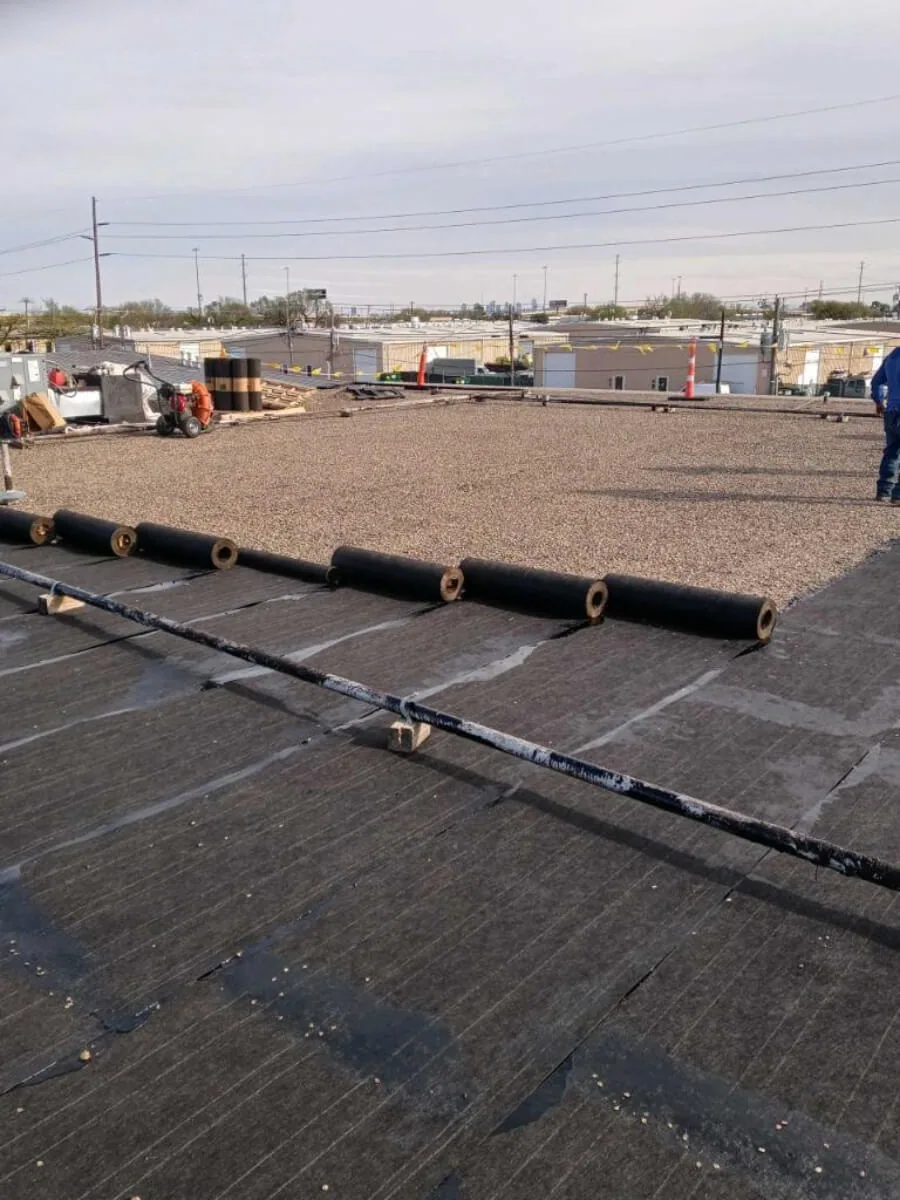
On modified bitumen and built-up roofs, the surface shows age first. We look for granule loss, open laps, blisters, splits at flashings and alligatoring in the coating. Then we count plies at a core and check whether the felts are dry.
A section with dry plies and local damage can be repaired. A section with wet plies across its area is a capital line, and the sooner the owner knows, the cheaper the plan. Each section of modified bitumen or built-up roofing is rated at every visit, so a change shows up beside the last set of photographs.
Flashings on layered roofs are built up in plies on a vertical face, and the top edge at the wall is where sealant gives out first. We reseal terminations, replace cracked pitch pockets and check counterflashing during routine visits. Those are small items, and left alone they are how an old mill roof starts leaking along its parapet.
Inspect Single-Ply Sections for Seams and Details
On single-ply sections the seam is the finding. We probe welded or adhered seams, check flashing terminations at walls and curbs and look at fastening near edges. Corners, curbs and penetrations open first, and a quarter-inch gap at a boot is the kind of small thing that becomes a leak over a tenant's ceiling.
Repairs follow the published details for the system, with matching materials. The log records the product, the method and the weather, with photographs taken before and after the work. A patch that looks fine and bonds poorly is worse than no patch, so surface preparation gets its own line in the log.
Drains get a separate look. A strainer packed with debris holds ponded water on the roof, and ponded water is the item most warranties limit. Each drain is photographed at every visit, with a note of how long water stood after the last rain, so the file shows the drains were clear when it counted.
Weigh the Heat and the Storm Season
Roofs here age under summer sun and heavy rain more than under snow load: July highs average 90.7 degrees, yearly precipitation is near 44 inches and snow adds only about 1.2 inches. A dark membrane in afternoon sun runs far hotter than the air, and sealants and seams age on that schedule.
Wind is the other test. An EF-1 tornado crossed the county on May 8, 2024 at an estimated 110 mph, lightly damaging roofs on several buildings and taking part of one East Gastonia warehouse roof. After a storm like that, we check edges, coping and the first rows of fasteners before anything else.
Remnant tropical systems reach this far inland. Hurricane Hugo arrived in Charlotte on September 22, 1989 with gusts of 87 mph, and Charlotte went through a December 2002 ice storm that left more than 1.3 million people without power. Both are reasons to keep a dated photo log, because the log is how an owner shows what changed.
Put a Price on Waiting
Each item in the report carries a pair of figures: what it costs to act now and what waiting is likely to cost. A reseal at a parapet is a small line this quarter. The same parapet after a wet summer can mean wet insulation, interior damage and a larger scope. The second number is not padded. An item that can wait two years without consequence is labeled that way.
That clarity is the point. The report is built so an owner can rank work for a partner or a lender, and decide whether to repair this year and replace in four. Sometimes the answer is exactly that, and we say so.
Where wet layers appear in several places, the plan points to a replacement and a decision date on the budget calendar. Dry layers with local damage mean a repair and no new capital line this year. The blunt line: the roof tells us which one it is.
Match the Inspection to the Building
Between Gastonia and Lowell, the Gateway85 corridor sits on about 365 acres, and its 1.5 million square foot distribution center opened in April 2023. Gastonia Technology Park spans 422 acres, and the five-story Loray Mill is among the legacy mills turning into apartments and mixed use.
Each roof is identified before work is quoted, and the result is entered in the file for the next visit.
Mixed-use conversions add a wrinkle. When a mill becomes apartments, the roof now sits over finished units, and a small leak reaches a resident's ceiling fast. We note which sections are over occupied space, so repairs can be scheduled around the people below and so the owner can see which sections carry the most consequence.
Keep a Warranty File That Holds Up
For roofs under coverage, the warranty file holds the document, installation records, every inspection and repair, and notes on work by other trades. Single-ply and bituminous categories overlap with those from Carlisle SynTec and Johns Manville, and the file format is the same.
Each visit ends with a photo log, a findings list and a short note on the cost of waiting for each item. The owner can hand it to a partner, a lender or an adjuster without a cover letter. We install and repair these system types; the manufacturer sets its own warranty terms.
Commercial Roofing Questions
Do you work on GAF roofs?
We inspect, repair and maintain the single-ply, modified bitumen and built-up system types GAF supplies, with products and warranty terms taken from the owner's documents.
Can you tell what is on my roof?
Usually. Cores, labels and installation records identify it. When they conflict, we report the conflict.
Will a repair affect my warranty?
Not when the repair follows the terms; the document is read first and the repair record is kept.
Is a recover possible over an older asphalt roof?
Sometimes, when the insulation is dry and the deck can carry another layer. Cores settle it.
What does the report tell me about cost?
It gives the cost to act now and the likely cost of waiting for each item, so you can choose the timing.
Topic
GAF Commercial Roofing Systems
Roof Types
Low-slope and metal
Related Roofing Work
Modified Bitumen Roofing
Built-Up Roofing