Church and House of Worship Roofing in Gastonia, NC
A water stain on the sanctuary ceiling is the sort of finding a congregation talks about long before a roofer sees it. Usually the cause is not the big pitched roof overhead. It is a valley that holds leaves, a flashing at the base of the steeple, or a flat section over the fellowship hall that ponds after every storm. The finding is modest. What it means for the trustees is not: a repair now is a line item, a replacement is a capital campaign, and a ceiling that falls on a Sunday is a crisis.
Churches in Gastonia, NC live under July highs near 91 F, steady rain, and spring wind like the May 2024 EF-1 tornado's. The walk is built for the building committee. Each finding gets a photograph, and the write-up is shaped so a trustee can lift any paragraph into a meeting memo, with a price for acting now and one for waiting.
Sort the Sanctuary from the Additions
Most churches are built in pieces: a sanctuary from one era, a fellowship hall from another, classrooms or a gym added later. Each piece may have a different roof, a different age, and a different problem. A steep sanctuary roof with shingles or panels needs ridge, valley, and flashing checks. A low-slope hall roof needs drains, seams, and curbs checked. We walk each section, record what is on it, and rank the sections by risk.
That ranking lets a committee fund the worst section first, without replacing a sound roof by accident. Photographs travel with the ranking. A volunteer who has kept the roof going for years often knows its history better than any record, and we ask for that history at the start: which leaks were patched, by whom, and when. That oral record goes into the file beside our own findings, and it saves the committee from paying twice for knowledge it already has. A public building with a long patch history follows the same pattern.
Check the Valleys, Steeple, and Wall Joints
Water collects where roofs meet. Valleys between sanctuary and wings carry heavy flow and fill with leaves. The base of a steeple or bell tower is flashed by hand and moves with the wind. A wall that rises through a roof needs step flashing and counterflashing, and cracked sealant there lets water behind it. These are the details we check first, because they cause most church leaks and they are inexpensive to fix when found early.
A flashing that has pulled away from masonry can be repaired in a day. A ceiling that has absorbed water for a year is a larger job. Our work on flashing failure repair follows that order. Gutters and downspouts get the same attention. A gutter that overflows at a masonry wall sends water into a joint that was never meant to carry it, and the stain appears inside weeks later. Clearing the gutter before the fall leaves drop is the cheapest line in a church roof budget, and the photograph of a clean gutter goes in the file with the date.
A clean photograph of a valley in October, taken after the leaves have dropped and the gutters are cleared, is worth keeping in the file. It shows the trustees the roof was cared for and gives the next walk a baseline.
Fix the Flat Roof Over the Hall
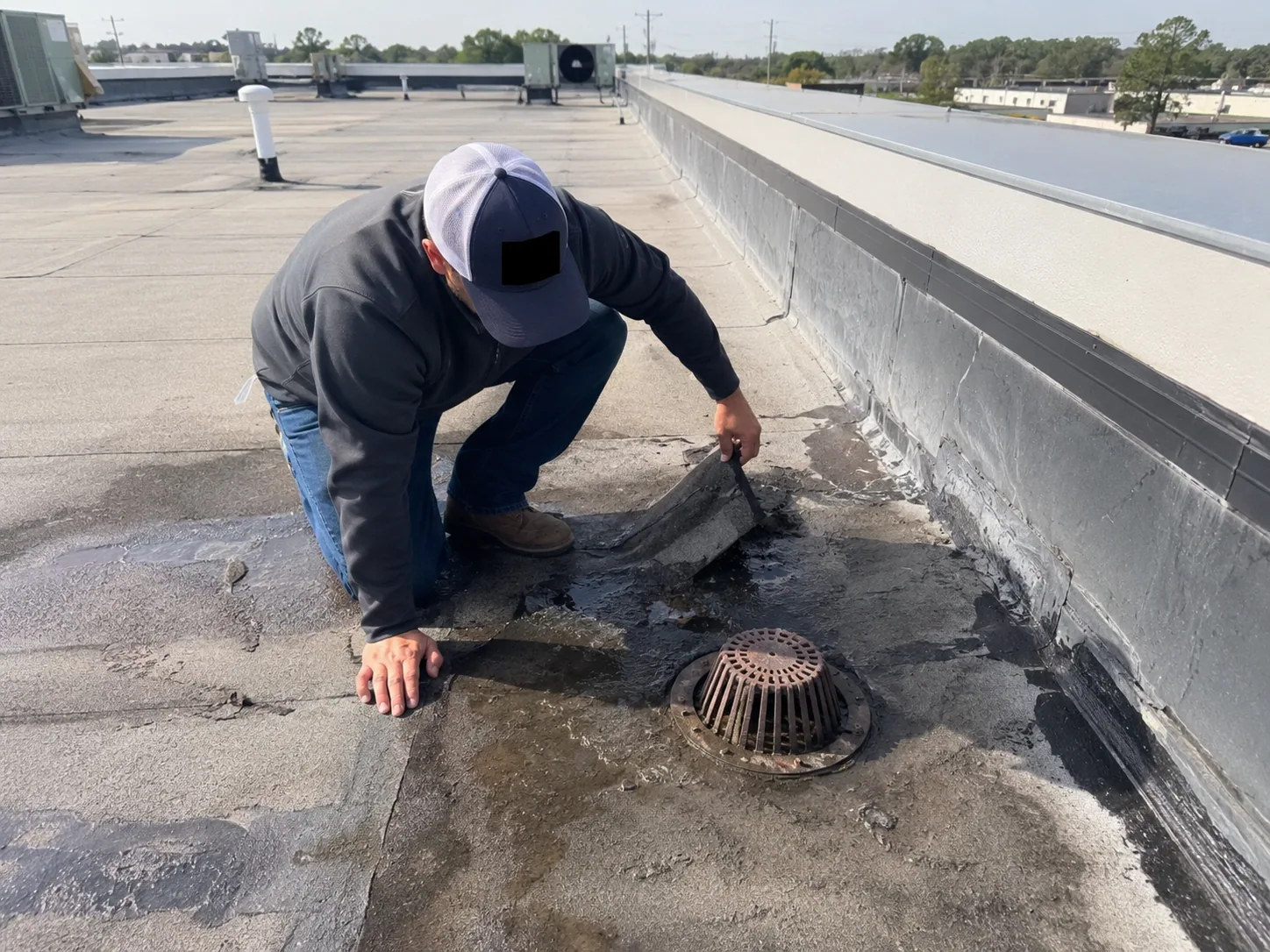
A flat or low-slope section over a fellowship hall, kitchen, or classroom wing works differently from the sanctuary. Water leaves through drains and scuppers, and if they clog, water ponds. Ponded water ages the membrane, adds weight, and finds seams. We clean drains, measure how long water stays, and look for the dirt ring that marks the pond. If cleaning does not solve it, a taper or a new drain does, and the fix is priced by itself. A kitchen exhaust fan on the roof adds grease to the list. Air handlers over a fellowship hall add curbs, and curbs add sealant that cracks in July heat near 91 F. We check each curb corner, count the units, and note which ones have been moved or replaced, since an added unit often sits on a patched curb. The notes help the committee when a mechanical contractor comes to quote on new equipment.
Schedule Around Services and Events
A church has a rhythm of services, weddings, funerals, and weekday programs. Roof work should not collide with them. We plan around the calendar the trustees give us, keep staging away from entrances and parking, and schedule noisy steps for weekday hours. A funeral on a work day changes the plan, and we can adjust. The roof is sealed by evening each day, and the access route is clear before the next gathering. Material is delivered when the lot is empty. Ladders and lifts are placed away from the doors people use, and the crew leader walks the site before each service day to remove anything left out. If the congregation holds a weekday school or a childcare program, we agree on quiet hours and keep the work area fenced.
Our approach to occupied building reroofing is built for this: the building stays in use, and the congregation knows the schedule.
Decide Between Repair and Replacement, and Plan the Money
A roof with dry decking and sound materials can be repaired and maintained. A roof with widespread leaks, rotted decking, or worn-out surfaces is a replacement, and a congregation needs time to plan the money. Our written findings include a repair-now list, a watch list, and a replace-by estimate, so the trustees can set a budget over several years. The building department tells us which edition of the state code governs the permit. The cost drivers are the roof area, the pitch, the amount of decking to repair, and the access needed for steep sections and a steeple. We price each separately. Many congregations want to phase the work over two or three years, and a plan that puts the worst section first and the soundest last fits that budget and keeps the building dry.
Walk the Roof After Storm Season
Gaston County saw two tornadoes in recent springs, in May 2020 and again on May 8, 2024. A tall steeple and a steep roof catch wind. After a storm, we check the ridge, the steeple base, and the edges. Congregations in Gastonia, Cramerton, and Belmont can request the same walk, and a school roof on a church campus follows similar checks.
Commercial Roofing Questions
How do we know whether to repair or replace?
Core cuts, a moisture scan, and a walk of the decking tell us. We give the trustees both a repair price and a replace-by estimate.
Can services continue during roof work?
Yes. We schedule around services, keep entrances clear, and avoid noisy steps during gatherings.
What if the steeple is damaged?
We inspect it from the roof, check flashing and fasteners, and recommend repairs. Taller work may need a lift.
Can the work be done in phases?
Phasing is common. We rank sections and price each phase so the budget can follow the roof. A phase that finishes before winter keeps the next rain season from reaching an open section, and the plan shows which phase falls in which year.
What records should the church keep?
Photos, repair invoices, and our written findings. They help with insurance and with future planning. Keep them with the building records, not in a single person's email, so the next set of trustees can find them.
Topic
Church and House of Worship Roofing
Roof Types
Low-slope and metal
Related Roofing Work

Government and Municipal Building Roofing
Failed Flashing Repair