Medical Office and Clinic Roofing in Gastonia, NC
Rust streaks running down a rooftop exhaust duct, above a stained ceiling in a lab corridor, tell a roofer where to start on a medical building. The duct is shedding condensate or rain onto the membrane, and the membrane under it is taking the water. The owner ends up needing a record that the practice, the landlord and sometimes a regulator will ask for: where the water came from, what it touched and what was done.
For a practice in Gastonia, NC the walk covers every penetration, with each finding photographed and the repair-or-replace answer written down. A leak over an exam room reaches a crew at any hour.
Know the medical market
Next to Gaston Memorial Hospital sits the Summit at Court Drive, a 60-acre medical and office park, and CaroMont Regional Medical Center ranks among Gastonia's major employers. Health services are one of Gaston County's industry clusters, and Atrium Health is among the county's employers. In Charlotte, a six-story outpatient facility on West Tyvola Road, the Charlotte VA Health Care Center, replaced an older site about a quarter its size.
A clinic suite in a park, a stand-alone practice and a converted building each have a different roof and a different history, and the first walk records which one we are on.
Parking and access matter as much as the roof. A park with shared lots and one drive in needs a staging plan that leaves patient parking alone, a lift position that does not block a fire lane and a delivery route that avoids morning appointment traffic. We settle those at the first visit and write them into the scope, so the practice never learns about the work from the crew.
Walk what runs through the roof
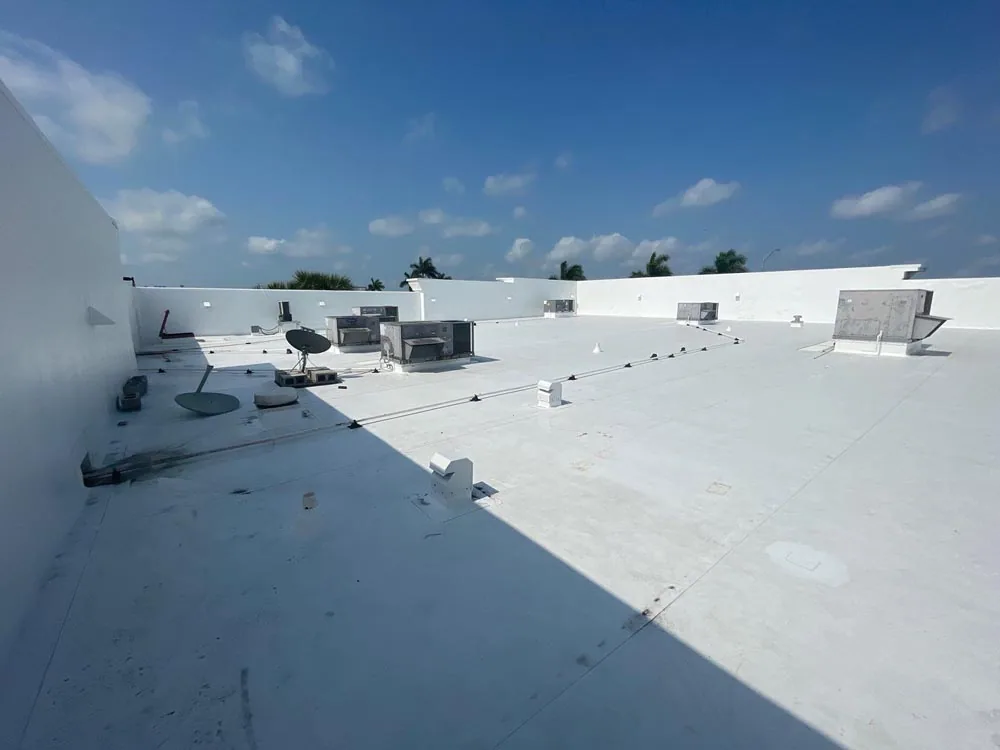
Medical buildings have many penetrations: plumbing vents, restroom and lab exhaust, rooftop units for each suite and sometimes medical gas or vacuum exhaust. Each has a flashing, and each flashing is a place for water to enter. Units added when a suite was renovated are easy to flash badly.
On a walk we list every penetration, photograph its flashing, probe the seams around it and rate its condition. We mark which suite each unit serves, so a leak at a curb reaches the right tenant. We also look for abandoned penetrations from past renovations, and we flag them for removal. The photo log becomes the roof record for the building.
Moisture can start inside a clinic. Sterilization rooms, labs and restrooms push humid air upward, and a poorly vented space condenses on the underside of the deck. The stain looks like a leak and is not. We check exhaust runs and ceiling-space conditions before we blame the membrane, so the repair matches the cause and the practice does not pay for a patch that cannot work.
Protect intakes and patients
Roof work above a care area follows the practice's rules. Air intakes near the work are marked and either shut down or protected, wet cutting and clean-up each shift hold dust down, and noisy steps stay out of appointment peaks. Entrances and accessible paths stay clear, so patients with limited mobility never cross a work zone.
The practice's own rules are requested at the first visit and written into the plan. For an occupied building, occupied building reroofing means phased sections, a watertight finish each day and a named contact for staff. Emergency repairs proceed at any hour, with water stopped first and permanent work scheduled with the practice.
Records matter in healthcare. Every roof opening, repair and clean-up is photographed and logged with the date, the area and the materials used. If a regulator, insurer or landlord asks what was done above a procedure room, the file answers in minutes. We deliver the same record at close-out, with product data and warranty notes.
Price the cost of waiting
Rebuilding a flashing this quarter is a modest line item. Water allowed to run through a wet spring soaks the insulation over exam rooms, and a closed ceiling holding wet insulation can grow mold. Then the repair is a ceiling, a roof section and a closed room. A practice that loses clinic days to a leak counts that cost too.
Heat works the seams and rain looks for an opening, with July highs in Gastonia near 90.7 degrees and precipitation around 44 inches a year. A practice can choose repair now, a limited repair that holds a season, a recover or replacement, and each choice carries a decision date. Cost follows wet insulation, access, units, penetrations and the system chosen.
How many years of service remain belongs on the capital line. A medical office roof with sound insulation and a worn membrane stays in upkeep. As its end comes into view, replacement is priced with time to bid the work around clinic hours. Mid-life roofs receive a limited repair, and a repeat finding on the next walk puts replacement on the calendar.
Choose repair or replace
Repair is right when the insulation is dry and the failures are few. Commercial roof repair around a rebuilt flashing is often enough. Recover only if the old roof is sound and dry. Replacement follows once moisture has spread or a membrane can no longer hold a repair, often with a reflective system such as TPO.
A moisture survey makes the call. An infrared moisture survey shows wet insulation from above with no cutting, which matters in a building full of patients. A larger hospital campus adds more intakes and stricter rules, and a nearby office building carries fewer.
Tenant improvement work and roof work often collide. A suite that is being gutted for a new practice may have a rooftop unit moved, a vent added or a curb reset, and the roof is opened by a trade that does not own the warranty. We review the plan for roof penetrations before the work begins and check the finished details afterward, so the roof is never the forgotten line in a renovation.
Weigh the storm record
Gaston County took two tornadoes in recent years, an EF-1 with estimated 110 mph winds on May 8, 2024 and a smaller one in May 2020. After a hard storm, we walk the roof, check edges and units and clear drains, since a storm opening over a care area is the failure everyone wants to avoid. A Gastonia practice gets the same storm walk as any other.
Commercial Roofing Questions
How do you protect air intakes during roof work?
We mark intakes on the plan, sequence tear-off and hot work away from them and shut them down or protect them with facility staff when needed. Dust and odor control is written into the scope.
Can exam rooms stay open during roof repairs?
Often, with limits. Rooms directly under open work may close briefly. We schedule around appointment peaks and tell staff which rooms are affected each day.
What does a moisture survey add for a clinic?
It shows wet insulation without opening the roof or the ceiling. Repairs can be cut to the wet area, and staff know which rooms to check.
Why do renovations cause roof leaks?
New units and vents are cut through the roof by trades that are not roofers. Flashing is easy to do badly. We check every penetration that does not match the original drawings.
What do you need from a practice?
The roof age, a floor plan showing exam rooms and intakes, the staff leak log and repair invoices. A findings summary comes back in writing and answers repair or replace plainly.
Topic
Medical Office and Clinic Roofing
Roof Types
Low-slope and metal
Related Roofing Work
Occupied Building Reroofing
Commercial Roof Repair